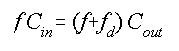
The feasible steady-state operating conditions of process equipment are limited by the decisions made at the equipment design stage. These decisions place limits on the range of movement of the manipulated variables (usually by control valve sizing) which restrict the available control effort. For example, consider a simple dilution system where a concentrated salt stream is diluted by a solvent stream. At steady-state the component balance becomes:
if the following nominal conditions are assumed:
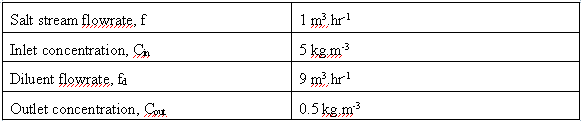
and we assume that the manipulation, the diluent flowrate, can be varied between 2 and 12 cubic metres per hour ( the upper limit is set by size of the control valve and the lower limit by the valves range-ability - I've just pulled the numbers out of mid air!), then we can calculate the range of conditions (values of flowrate and inlet concentration) at which the process can be controlled at steady-state. We do this by rearranging the equation to give the inlet concentration as a function of the flowrate and insert the nominal outlet concentration (the control objective) and the upper and lower limits of the manipulation. This gives two equations:
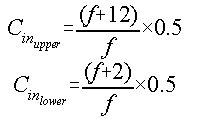
These equations can be plotted to produce the 'control envelope' for this process:
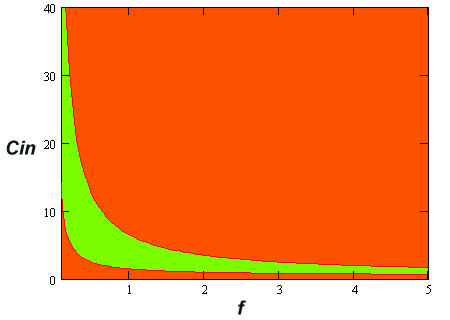
Controlled operation of this process at an outlet concentration of 0.5 is only possible if the process conditions fall within the green area of the graph - steady-state operation is impossible in the orange area.
You should also note that although steady-state operation is possible near the edges of the green area, the dynamic performance of a control system may be rather poor. Cranking up the gain on a controller which is hitting a constraint won't increase the rate of response, but will cause significant oscillation when the system comes off the constraint (trying to tune a system when it's hitting a constraint is quite a common mistake).
Decisions made during equipment sizing can have a major influence on the controllability of a process. As a result it is now common for control and equipment design to be much more integrated than they were in the past.