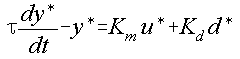
In the modelling section of the course you saw that some processes exhibit open loop instability. Process models which exhibit this can be identified by looking at the roots of the characteristic equation - if any roots have positive real parts the process is unstable.
We can use proportional action to stabilise some of these open loop unstable systems, e.g. consider the unstable process:
Proportional action can be added to the process as follows:
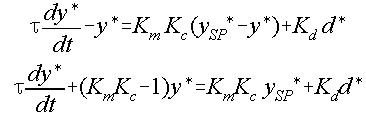
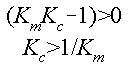
Now, this closed-loop equation will be stable (the roots of the characteristic equation will be negative) if:
The same can be done for second- and higher-order processes, for example:
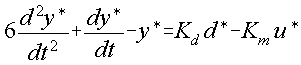
is an exponentially unstable second-order process (roots are +0.5 and -0.333)
Applying proportional control gives:
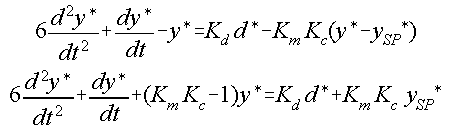
and the roots of the closed loop characteristic equation are:

To avoid positive roots:
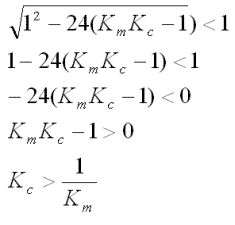
The roots of this equation will be negative provided the controller gain is greater than 1/Km. Note that if the gain is greater than 25/24Km then the controlled response will be underdamped (since the roots are complex), but NOT unstable.
Interestingly, integral control on its own doesn't stabilise an open-loop unstable process:
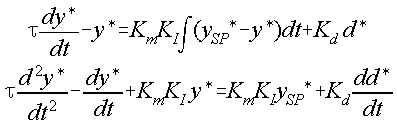
gives roots for the characteristic equation of:
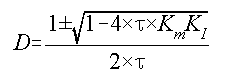
there is no value of KI that will prevent at least one of the roots from being positive - it is impossible to stabilise the process with integral action alone - this is a general result. Integral action can, however, be used alongside proportional action to control unstable processes if offset free control is required.
As well as stabilising unstable processes, control can destabilise open loop stable processes. There are two ways this can happen: