
In an earlier section I derived a simple model for a chemical reactor. The reaction taking place was the irreversible conversion of compound 'A' to compound 'B' with no side reactions or additional reactants. The final equations I obtained were, for the 'A' balance:
and for the 'B' balance:

For the purposes of this exercise let's assume that we want to examine the response for changes in both F, the flowrate through the reactor, and Cain, the inlet concentration of 'A'. If these quantities are allowed to vary, both the 'A' and 'B' balances will have combinational non-linearities (the 'A' balance has two and the 'B' balance has one). Have a go at linearising the two equations. My solution is given below:

These equations look a bit messy because I've solved them symbolically - I haven't inserted values for the steady-state components arising from the linearisation. To tidy things up let's assume the following nominal operating conditions for the reactor:

NB: these values should produce a steady-state - if they don't I've made a mistake. When putting together control experiments for yourself always make sure that your nominal condition is a steady-state. If it isn't then you'll mix up any response you're trying to produce with the system moving towards its actual steady-state.
Inserting these conditions into the balances produces:

The 'A' balance is simply a linear first-order differential equation, and we already have a standard solution for this equations response to a step. The responses to a 1% step in the flow and inlet concentration are:

Solving the 'B' balance analytically is more complicated. Although the balance is a first-order differential equation, one of the inputs to the equation (CA*) is itself an output of another differential equation. To solve the equation it is necessary to do a bit of maths. To simplify things let's just look at the solution to a change in the inlet concentration:
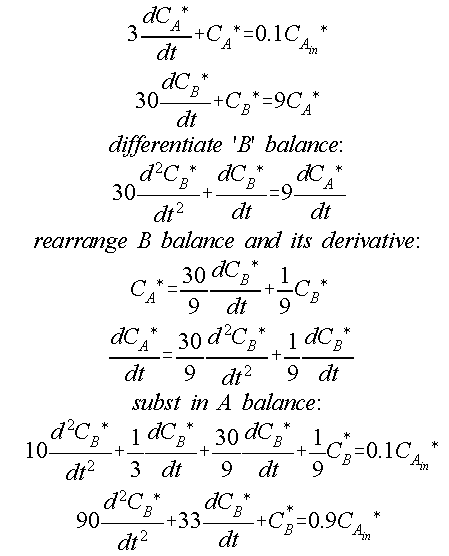
This is a second-order differential equation (note the rearrangement into standard form - the multiplier on the CB* term is 1). You should now from the standard second-order solutions to a step change that the solution is dependant on the roots of the characteristic equation of the process. In this case the characteristic equation can be represented as:

the roots of this equation are -0.033, -0.333. The roots are negative, so the response is stable, and they are real and distinct - the response is second-order overdamped. The steady-state gain of the process is 0.9 so the final change in the output will be 0.9 the size of the input step (in this case 0.9*0.01*50 = 0.45, so the final value of CB after the step should be 45+0.45 = 45.45).
The numerical solution of the reactor balance can be found here.
The dynamics of this process are quite interesting. The concentrations of the two components A and B change at significantly different rates - this has important implications for control as different controllers would be required depending on whether CA or CB were to be the controlled variable.