No general analytical techniques exist for the solution of non-linear differential equations. Since virtually every dynamic model of a processing operation will include non-linearities, it is necessary to find a way of approximating these non-linear equations with linear equations that can be readily solved. The procedure for doing this is called Linearisation. Linearisation consists of substituting any non-linear terms in an equation with linear approximations. Depending on the number of variables involved in the non-linear terms, these linear approximations can be lines, planes, cuboids, or hyper-planes.
Mathematically speaking, linearisation involves approximating a function from the first order terms of its Taylor series. Thus
becomes simply
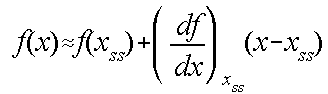
or, if expressed in deviation variables, even more simply
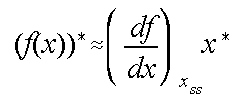
Geometrically speaking, what is actually being done is that a non-linear curve is being approximated by a straight line ( a linear function) which passes through xss , the point of linearisation, at a tangent to the curve at that point. The accuracy of linearisation is proportional to the size of the second order terms in the Taylor expansion - so approximations of curves with fast changing gradients, or of points far away from the point of linearisation will become increasingly inaccurate as these terms increase.
Consider the balance for a tank with a free-draining gravity discharge

this equation clearly possesses a functional non-linearity which would need to be removed prior to analytical solution. The first step is to convert the equation to deviation variables:
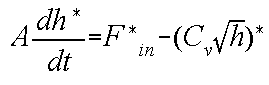
Note that the deviation is taken of the entire non-linear term. We can now linearise the non-linearity:
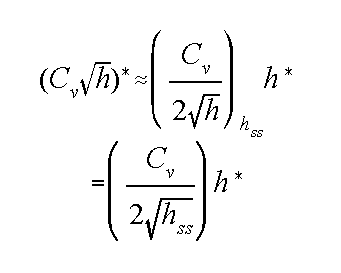
Although the linearised expression contains a square root expression, it is the square root of a constant value, and the entire expression inside the brackets evaluates to a constant ( which is the gradient of the function at the point of linearisation). This is, then, simply an equation of a straight line of the form y=mx. The last part of the linearisation process is to replace the non-linear term in the differential equation with its linear approximation:
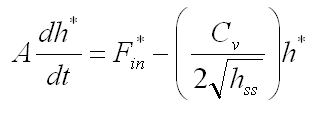
The linearisation of non-linear terms involving multiple non-linear terms follows exactly the same procedure as that for single variable, except that the first-order terms of the multi-variable Taylor series are used:

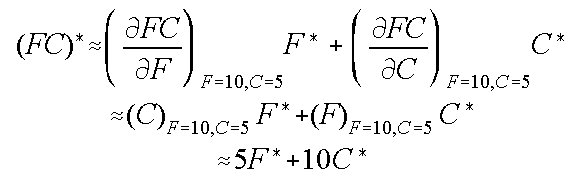
Linearise the function F.C about the point F = 10 cubic metres/hour and C = 5 kg/cubic metre.
Converting first to deviation variables: